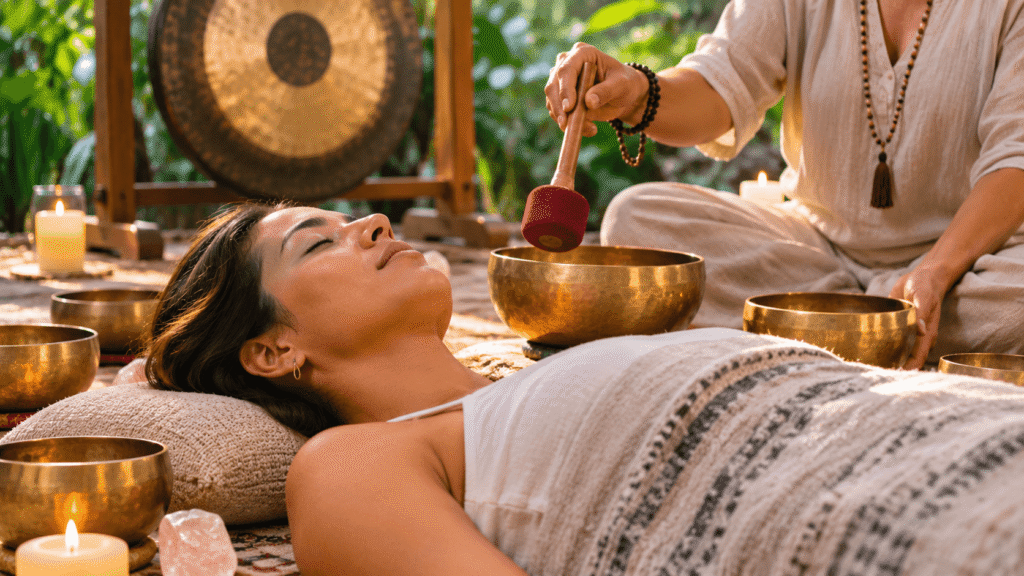
Sound healing is a guided relaxation practice led by instruments such as bowls, gongs and chimes. You lie down, close your eyes and listen while a facilitator plays for forty minutes to an hour. Most people describe it as somewhere between a meditation and a very deep nap.
The name promises more than the practice can show. The experience is real and often striking. The medical claims that sometimes come with it are another matter, and this guide keeps the two apart. It covers what happens in a session, the instruments, where the practice comes from, what the research says, how it differs from music therapy and how to prepare for your first sound bath.
What happens in a sound healing session
Sessions vary by facilitator, but most follow the same arc.
| Stage | Roughly when | What happens | What you may notice |
|---|---|---|---|
| Settling in | First 5 minutes | You lie on a mat with a blanket and an eye pillow; the facilitator explains the session | Some restlessness, which is normal |
| Breathing introduction | Minutes 5 to 10 | A few slow, guided breaths | Your shoulders and jaw start to loosen |
| Main sound journey | Minutes 10 to 45 | Bowls, gongs and chimes played in layers, building and fading | Drowsiness, heaviness in the body, losing track of time |
| Quiet descent | Last 10 minutes | Sounds thin out to single tones, then silence | A drifting, half-asleep state |
| Silent close | Final minutes | You lie still, then sit up slowly | Many people feel slow and calm for an hour or so afterwards |
Falling asleep is common and doesn’t spoil anything. Some facilitators will tell you it’s the most useful thing you can do. Others notice their thoughts wandering, memories surfacing or images appearing behind closed eyes, a bit like the moments before sleep. None of it is a sign of doing the session right or wrong.
Group sound bath or private session
Most people start with a group sound bath, where a room of people lie on mats and the facilitator plays for everyone at once. Private sessions are one-on-one. The facilitator can adjust the volume to you, talk through what you’d like beforehand and, if you agree, place bowls on or near your body so you feel the vibration as well as hear it. Group sessions are cheaper and easier to find. Private ones suit people who feel self-conscious in a group or want something quieter and more personal.
Other formats you might come across
A gong bath uses one or more gongs as the main instrument and tends to be louder and more intense than a session built around bowls. Some practitioners use tuning forks held near the ears or touched to the body. Vibroacoustic beds and tables send low-frequency vibration through the surface you lie on. Some sessions add voice, chanting or mantra. All of them share the same basic idea: you lie still and let the sound take your attention.
The instruments and what they sound like
| Instrument | Sound | Role in the session |
|---|---|---|
| Tibetan singing bowls | Warm, layered tones that hum long after each strike | The base layer; sometimes placed near or on the body |
| Crystal bowls | Purer, louder tones that seem to fill the room | Long sustained notes |
| Gong | A deep wash of sound that swells and recedes | The most intense moments, used sparingly |
| Chimes and bells | Short, bright notes | Transitions and the close |
| Ocean drum or rain stick | Waves or rainfall | Gentle background texture |
| Tuning forks | A clean, single pitch | Held near the ears or touched to the body in private sessions |
Despite the name, many “Tibetan” singing bowls are made in Nepal and northern India. The label describes a style more than a place of origin.
A bowl sings in two ways. Strike it with a padded mallet and it rings like a bell, then fades slowly. Run the mallet around the rim and the tone builds into a steady hum that can last as long as the facilitator keeps going. Crystal bowls, made from quartz, are louder and simpler in tone, and each one is usually tuned to a single note. A good facilitator mixes these sounds so that something is always changing, but slowly enough that you stop tracking it.
Where sound healing comes from
Sound has been part of ritual and meditation in many cultures for a very long time, from Buddhist and Hindu chanting to the drumming used in shamanic traditions. The modern sound bath is much more recent. It grew out of the Western wellness and meditation scene of the late twentieth century and became widely popular in the last decade or so, as yoga studios, spas and retreat centres added group sessions to their schedules.
The singing bowls themselves have a murkier history than their marketing suggests. Metal bowls have long been made in the Himalayan region, but records of them being played for sound meditation in Tibet are thin, and much of today’s practice is a modern development.
How sound healing might work
There’s no settled explanation, but a few ideas are reasonable without making large claims.
The first is the setting. You lie still in a warm, dim room with your eyes closed and breathe slowly, which on its own tends to move the body toward rest: breathing and heart rate slow and muscles let go. Most relaxation practices work this way, and a sound bath makes it easy to stay in that state for an hour.
The second is attention. Many people find it hard to sit and empty their mind. Long, changing tones give the mind something to follow without any effort, which is why sound meditation often feels easier than silent meditation to beginners.
The third, and the most often repeated, is brainwave entrainment: the idea that steady sounds nudge brain activity into slower patterns linked with drowsiness. Lab research shows that rhythmic sound can influence brain activity, but there’s no good evidence that a sound bath does this in a way that matters for health. The same goes for claims that vibration from bowls repairs cells or organs. You can feel the vibration, and many people enjoy it, but that is as far as the evidence goes.
What sound healing is, and what it isn’t
| Claim you might hear | What can honestly be said |
|---|---|
| It helps you relax | Well documented as a relaxation practice; this is its main and most reliable effect |
| It reduces stress | Small studies report people feeling less tense after sound meditation, which matches most participants’ experience |
| It’s easy for beginners | True. It needs no technique and no held posture |
| It helps you sleep | Many people sleep well the night after a session; there’s no good evidence of a lasting effect on sleep disorders |
| It cures illness or “realigns” the body | No reliable evidence; it doesn’t replace medical or psychological treatment |
| Specific frequencies heal specific organs | No reliable evidence |
| 432 Hz or solfeggio tones are especially healing | No reliable evidence; these tunings are a matter of taste |
What the research says
Research on sound healing is limited. One of the most cited studies, an observational study published in 2017, found that people reported less tension, anger and fatigue after a singing bowl meditation. It had no control group, though, so it can’t separate the effect of the bowls from the effect of lying down quietly for an hour. A 2020 systematic review of singing bowl research concluded that the studies were too few and too weak to draw firm conclusions about health effects.
Most of the research shares the same problems: small groups, short follow-up and participants who know what they’re receiving and expect to feel better. Sound baths can still help people relax, and the claim the evidence supports is a modest one: a pleasant, easy way to rest, with effects similar to other relaxation and meditation practices.
Sound healing and music therapy
The two are often confused. Music therapy is a clinical profession. Music therapists are trained and credentialed, work with patients in hospitals, rehabilitation centres, schools and mental health services, and set goals for each patient, often with active music-making such as singing, drumming or songwriting. Its research base is much larger.
Sound healing is a wellness practice. Facilitators’ training varies widely and there’s no standard licence, and the aim is relaxation rather than treatment of a specific condition. Both can be worthwhile, but if you’re looking for help with a health problem, music therapy is the one built for that.
Sound bath for beginners: what to expect
A sound bath and a sound healing session are, in practice, the same thing. You don’t need meditation experience, and there’s nothing to get right. Before your first one:
- Wear loose, warm clothes; body temperature drops when you lie still.
- Eat lightly in the two hours before.
- Arrive ten minutes early to settle in.
- Tell the facilitator about tinnitus, sound sensitivity or pregnancy, so they can adjust volume or keep bowls off the body.
- Leave the next hour free if you can.
During the session, get comfortable before it starts: a pillow under your knees helps if your lower back aches when lying flat. You can shift position, open your eyes or sit up at any time. At the end, roll onto your side before sitting up, and take a moment before standing, since some people feel light-headed after lying still for so long. Drink some water afterwards.
Is sound healing safe?
Sound meditation suits most people. If you live with epilepsy, a psychiatric condition or recent trauma, talk to your doctor or therapist first and let the facilitator know. Intense sound and deep relaxation can bring up more than expected.
Even for everyone else, a session can occasionally feel emotional, and some people find gongs too loud or the vibration unpleasant. You can ask the facilitator to keep the volume down or the bowls off your body, and you can leave if it doesn’t feel right. If you’re pregnant, check with your doctor first and ask for bowls to be kept away from your abdomen.
Choosing a facilitator
Since training isn’t standardised, it’s worth asking a few questions. Where did the facilitator train, and how long have they been running sessions? How loud does it get, and will they place instruments on your body? A good facilitator asks for your consent before any touch and is happy to explain what they’ll do. Be wary of anyone who promises to cure a medical condition.
How often to go
There’s no set dose. Some people go once as an experience, others make it a weekly or monthly habit, much like a yoga class. If you come out feeling rested, that’s reason enough to go back.
Trying sound meditation at home
Recordings won’t give you the vibration or the room, but they’re an easy way to see whether you like the sound. Lie down somewhere quiet, keep the volume low and give it twenty minutes or so. Headphones help block outside noise. If you enjoy it, a single singing bowl is inexpensive and simple to learn: strike it, listen until the tone fades and strike it again.
Trying it in Medellín
Wake BioHotel includes sound sessions in its experience schedule, so guests can book one as part of their stay. If you’re looking for a hotel in Medellín built around calm, our luxury rooms in El Poblado, Medellín make it easy to fit a session into a weekend.
What is sound healing?
A guided relaxation practice led by instruments such as bowls, gongs and chimes, usually experienced lying down.
Is a sound bath the same as sound healing?
In practice, yes. “Sound bath” usually refers to a group session, and “sound healing” is the broader name for the practice.
How long is a session?
Forty to sixty minutes, including a short breathing introduction and a silent close.
What does it feel like?
Most people describe deep drowsiness, a sense of physical heaviness and losing track of time.
Do I need meditation experience?
No. It’s among the most accessible practices because it requires no technique or held posture.
Does it have proven therapeutic effects?
It’s well documented as a relaxation practice, but it doesn’t replace medical or psychological treatment.
Is it the same as music therapy?
No. Music therapy is a clinical profession with trained, credentialed therapists; sound healing is a wellness practice focused on relaxation.
Can I do it while pregnant?
Check with your doctor first, tell the facilitator and ask for bowls to be kept away from your abdomen.
How often should I go?
As often as you find it useful. Some people go once, others weekly or monthly.