Most people accept sleeping badly on a trip as part of the price. The first few nights will be broken, jet lag is unavoidable, you adjust eventually. Some of that is true the body genuinely needs time to reset its internal clock. But a large share of what gets blamed on travel comes down to specific decisions that are entirely controllable.
This guide is about those decisions. Not supplements, not quick fixes, but the variables that consistently make the difference.
Before you leave: start moving the clock
The circadian system does not reset in one jump. The commonly cited estimate is roughly one day of adjustment per hour of time difference, though it varies widely between individuals and is slower travelling east.
If the shift is three hours or more, moving your bedtime 30 to 60 minutes earlier or later across the two or three days before departure noticeably reduces the impact on arrival. You do not need to make the full adjustment closing half the gap is enough to matter.
A less obvious point: sleeping badly the night before the flight, which is extremely common because of packing anxiety, carries the deficit straight into the destination. That night counts as much as the first ones abroad.
On the flight: less than you think
On flights under six hours, sleeping on the plane rarely helps and often disrupts more than it delivers. On long-haul, the most useful rule is simple: sleep only if it is night at your destination.
Three things that genuinely work:
- Hydration. Cabin air is very dry, and dehydration worsens the sensation of jet lag considerably.
- Minimal alcohol. It shortens the time to fall asleep and degrades the quality of that sleep precisely the opposite of what you need.
- Eye mask and earplugs. Unglamorous and remarkably effective. Blocking light and noise beats any breathing technique when the environment refuses to cooperate.
On arrival: light is the main lever
If you remember one thing from this article, make it this. Daylight exposure at the correct local times is the single most consistent factor in resetting the internal clock.
In practice:
- Arriving in the morning: go outside. A 30-minute walk in natural light is worth more than a nap.
- Arriving at night: dim the lights and avoid bright screens in the hour before bed.
- If you must sleep during the day, cap it at 20 to 30 minutes. Long naps delay adjustment rather than accelerating it.
Medellín adds a variable of its own: the city sits at around 1,500 metres. Not high enough to cause altitude sickness, but many people notice slightly lighter sleep for the first few nights and a lower tolerance for alcohol. Both normalise within two or three days.
The room: what actually matters
This is where most accommodation quietly fails. A room can be spacious, beautiful and immaculate and still make good sleep impossible. Four variables define the difference.
Effective darkness. Not thick curtains, actual darkness. No light leaking around the edges, no standby LEDs from appliances, no street light seeping in above the rail. Residual light in the bedroom interferes with the body’s rest signalling.
Sound insulation. Intermittent noise a door, a lift, a corridor fragments sleep even when it does not fully wake you. In a city like Medellín, where nightlife concentrates in very defined pockets, the building’s location matters as much as the window glazing.
Temperature. A cool room, roughly 18 to 20°C, makes it easier both to fall asleep and to stay asleep. The drop in core body temperature is part of the physiological process of falling asleep.
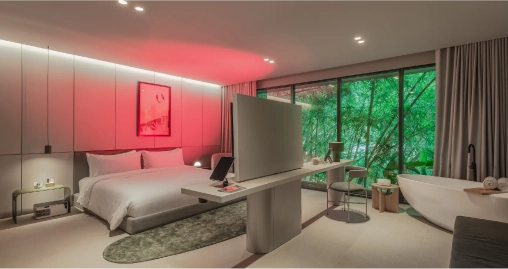
Warm light in the evening. Dim, warm-toned lighting after sunset rather than bright white light lets the transition towards rest happen without friction.
When those four are solved by design rather than by luck, the difference shows from the first night. It is the criterion worth applying to luxury rooms in El Poblado, Medellín beyond what the photos show.
An arrival routine that works
For an arrival in Medellín from North America or Europe:
- Arrival day. No long naps. Daylight, a gentle walk, a light and early dinner.
- First night. Go to bed at local time even without feeling sleepy. Cool, dark room.
- Second day. Morning light as early as possible. Moderate physical activity, no hard training.
- Second and third nights. Usually the best ones. The adjustment is essentially done.
The process works far better when the environment cooperates. Choosing a hotel in Medellín on the basis of rest rather than location alone changes the quality of the entire trip.
What not to do
Compensating with mid-afternoon coffee, training hard on arrival day, eating a large late dinner, or staying in the room with the curtains closed for the whole first day. All four are intuitive, and all four extend the adjustment period.
Frequently Asked Questions
How long does jet lag last?
A common estimate is around one day per hour of time difference, though it varies considerably between people and is slower travelling east.
What helps most with jet lag?
Getting daylight at the right local times is the most consistently effective lever, ahead of any supplement.
What room temperature helps sleep?
A cool room, roughly 18 to 20°C, generally makes it easier both to fall asleep and to stay asleep through the night.
Should I nap on arrival?
Short naps of 20 to 30 minutes help. Longer ones delay adjustment to local time rather than speeding it up.
What makes a hotel room good for sleep?
Effective blackout with no light leakage, real sound insulation, temperature control and warm lighting in the hours before bed.